

Al-Qur’an and the Sea: The Scientific Precision of Internal Waves in the Sacred Text
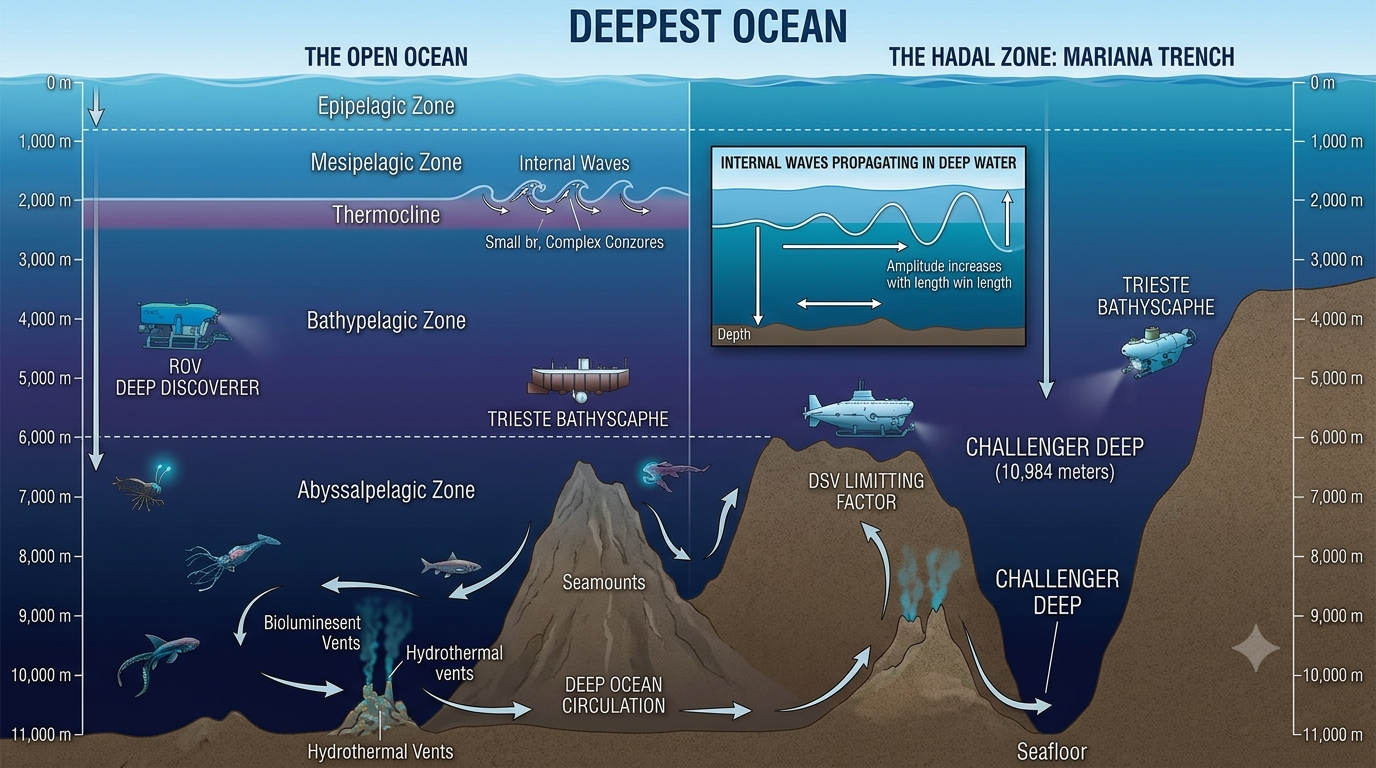
For generations, humanity looked out at the majestic, rhythmic crash of coastal tides, assuming the ocean’s dynamic life began and ended right where the sunlight met the brine. We watched the rolling surf, listened to the roar of the breakers, and believed that the visible surface was the absolute limit of the sea’s immense choreography.
Yet, far beneath that shimmering, sunlit skin lies an alien realm of absolute obscurity and unfathomable kinetic power – a hidden, crushing underworld that modern oceanography has only recently managed to decode through advanced sonar grids, satellite altimetry, and deep-sea submersibles.
What staggers the modern mind, however, is that long before humanity possessed the technology to pierce these abyssal depths, this exact oceanographic reality was captured with breathtaking, pinpoint accuracy in a text that emerged from the arid, landlocked dunes of the Arabian desert over fourteen centuries ago, Al-Qur’an.
Ocean Depth
To journey downward into the deep ocean is to witness a gradual, almost haunting erasure of the world we know. As a diver or a submersible descends past the two-hundred-metre mark, a threshold oceanographers call the ‘photic zone’, where sunlight begins to rapidly dissipate, filtering into a dim, twilight blue.
Continue down to one thousand metres, and the environment is swallowed entirely by a complete, impenetrable, starless darkness. In this zone, photon activity drops to zero, and the human eye ceases to function. Yet this pitch-black expanse is far from stagnant.
It is a realm of crushing pressure and relentless movement, where water masses of contrasting temperatures, salinities, and densities relentlessly collide. Out of these invisible thermal and saline frictions are born giant internal waves, submerged torrents that dwarf the largest waves seen on our surface in both physical size and raw energy, rolling through the deep-water columns like colossal, silent ghosts.
Discovery of internal waves
Astonishingly, the existence of these internal waves remained completely unknown to modern science until the twentieth century, when advanced oceanographic equipment finally mapped the interior layers of the sea. Yet, this intricate architecture of pitch-black abyssal darkness and dual-tier wave dynamics was vividly articulated during the seventh century.
The Al-Qur’an illustrates a profound spiritual reality by anchoring it directly to the exact physical mechanics of the deep ocean, recorded in Surah An-Nur: “Or [it is] like darknesses within a deep sea which is covered by a wave, upon which is another wave, above which are clouds; darknesses, some of them upon others. When one puts out his hand [therein], he can hardly see it.” This passage does not merely offer poetic imagery; it outlines a sophisticated physical truth.
It explicitly references a deep wave covered by yet another wave, mirroring precisely the modern scientific distinction between internal ocean waves and surface ocean waves. When dense, highly saline deep-water masses interface with lighter, warmer surface currents, the boundary friction generates massive, rolling swells deep beneath the water column. This intricate hydrodynamic phenomenon is distilled into a few immortal words: “A wave, upon which is another wave.”
Furthermore, the verse captures the absolute sensory deprivation of the deep abyss with clinical precision, noting that a person stretching out their hand in those crushing depths would remain utterly blind to their fingers. To fully grasp the magnitude of this revelation, one must look at the historical and geographical context from which it arose.
Arabs and the Sea
The inhabitants of the ancient Arabian Peninsula were people of the desert, nomads and traders surrounded by sweeping dunes and scorching winds. They were intimately familiar with camels, caravans, and arid expanses, but they were entirely unacquainted with deep-sea navigation, let alone marine biology or ocean physics.
They had never sailed the open global oceans, possessed no diving apparatus, and certainly never plunged thousands of metres beneath the waves to measure water densities, internal wave frictions, or light absorption rates.
The idea that a man living in the heart of the desert could organically deduce the multi-layered darkness of the deep sea and the existence of underwater waves is historically and logically impossible. The immaculate precision of these descriptions leaves no room for arbitrary coincidence or accidental poetry. It forcefully demonstrates that this knowledge could not have been a product of contemporary human observation or scientific experimentation. Instead, it stands as a timeless testament of a profound communication from the Architect of the universe that transcends the physical limitations of its historical era.
Ignorance of Deep Sea
For centuries, as science slumbered in ignorance of the deep sea’s true nature, the text waited patiently for human technology to catch up to its words. Today, as modern submersibles map the crushing depths and confirm the existence of internal waves, the Al-Qur’an shines brighter than ever, offering an enduring intellectual and spiritual marvel that continues to humble modern scientists, spark deep contemplation, and anchor the faith of seekers across the globe.
Join our whatsapp channel for all the latest updates.
For news coverage, article publication, and advertisement, send an email to ghanaianminaret@gmail.com or reach us via whatsapp, telegram or phone call on +233266666773.
DISCLAIMER: The Views, Comments, Opinions, Contributions and Statements made by Readers and Contributors on this platform do not necessarily represent the views or policy of the Ghanaian Minaret
Related Posts: